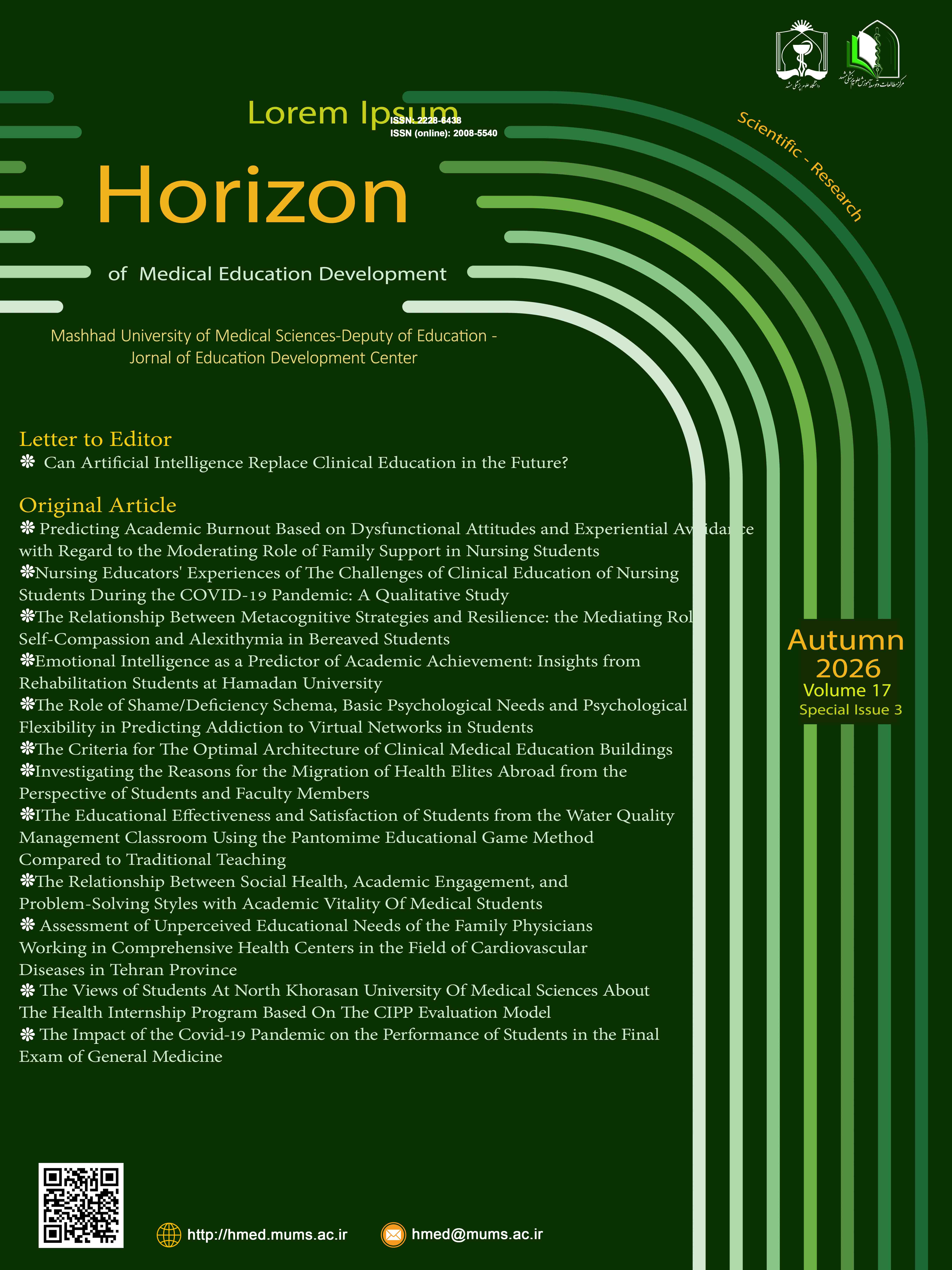
Document Type : Letter to Editor
Author
1
Associate Professor of Nursing, Department of Nursing, Zeyinab School of Nursing and Midwifery, Guilan University of Medical Sciences, Rasht, Iran
2
Social Determinants of Health Research Center, Trauma Institute, Guilan University of Medical Sciences, Rasht, Iran.
Abstract
Introduction: “In recent years, artificial intelligence (AI) has emerged as a central theme in the fields of medical science and health professions education. This letter to the editor examines the role of AI in clinical education, arguing that while AI can enhance certain aspects of the pedagogical process, it cannot replace the essential human elements inherent in traditional clinical training. The rapid evolution of this technology has drawn increasing attention to its potential role in clinical education. This shift raises a fundamental question: Can AI eventually serve as a complete substitute for traditional clinical education?”
Acknowledgments:The authors sincerely thank the Editor and reviewers for their valuable and constructive comments, which contributed to improving the scientific quality and enhancing the content of this letter.
Availability of data and materials:The datasets analyzed during the current study are available from the corresponding author on reasonable request.
Conflicts of interest:The authors declare that they have no conflicts of interest regarding the publication of the results of this article.
Consent for publication:Not applicable.
Ethical approval and consent to participate:As this letter to the editor does not involve data collection from human participants, ethical approval and informed consent to participate were not required.The study was conducted in accordance with the ethical principles outlined in the Declaration of Helsinki.
Funding:This study received no specific funding from any public, commercial, or non-profit organizations.
Authors’ Contributions:The author contributed to the conception of the manuscript, literature review, drafting, critical revision, and approval of the final version of the manuscript.
Open Access Policy: This article is licensed under a Creative Commons Attribution-NonCommercial 4.0 International License (CC BY-NC 4.0), which permits any non-commercial use, sharing, adaptation, distribution, and reproduction in any medium or format, provided the original author(s) and source are properly credited. To view a copy of this licence, visit.
https://creativecommons.org/licenses/by-nc/4.0
Keywords