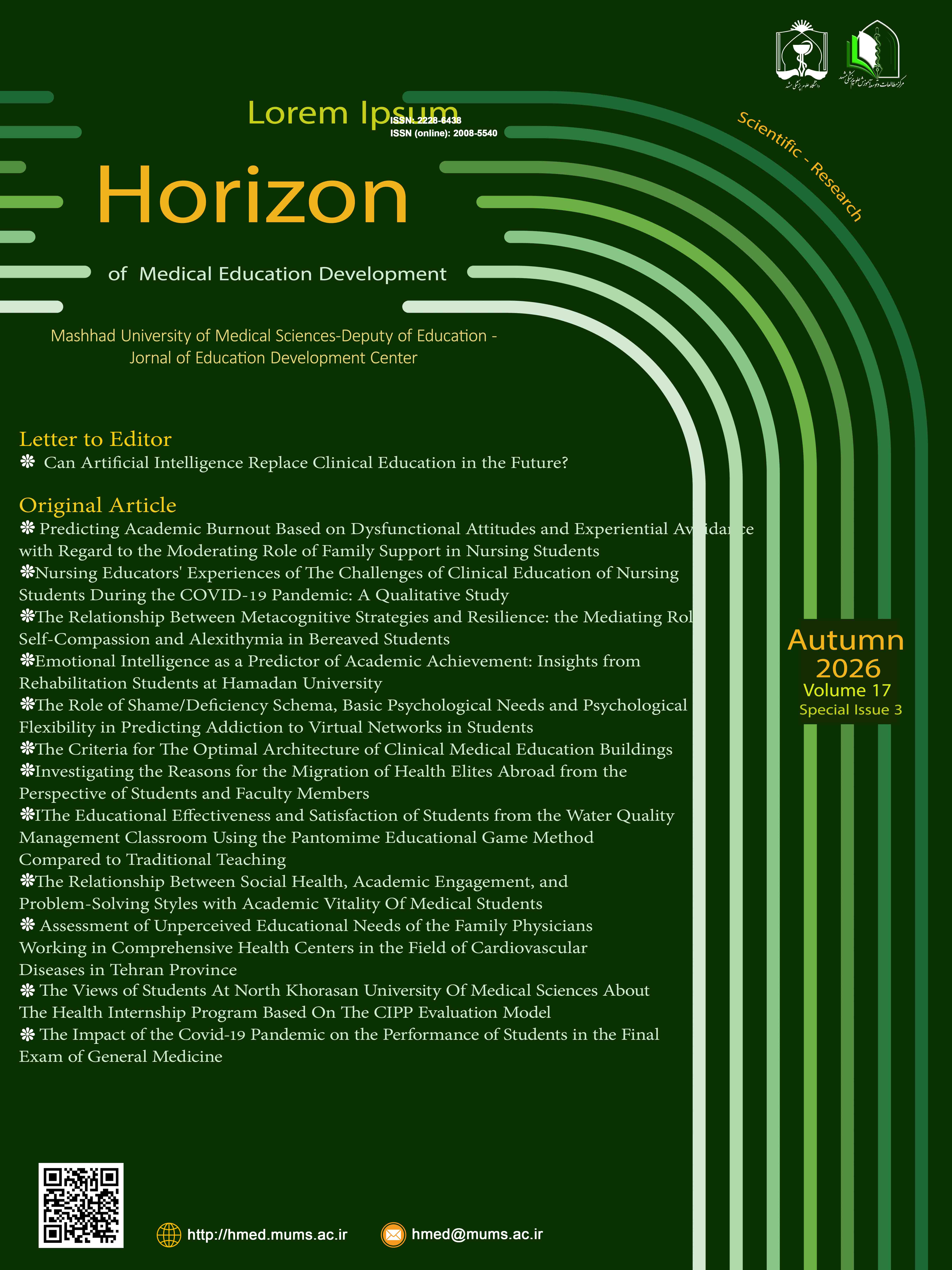
Document Type : Original Article
Authors
1
Department of anatomical sciences, School of medicine, Urmia University of Medical Sciences, Urmia, Iran.
2
Department of e-learning, School of Medical Education and Learning Technologies, Shahid Beheshti University of Medical Sciences, Tehran, Iran.
3
Department of Medical Parasitology and Mycology, School of Medicine, Urmia University of Medical Sciences, Urmia, Iran.
4
School of Medicine, Urmia University of Medical Sciences, Urmia, Iran.
5
Department of Health Information Technology, School of Allied Medical Sciences, Urmia University of Medical Sciences, Urmia, Iran.
Abstract
Introduction: The crisis of emigration of elites abroad and the need to benefit from the talents and abilities of elites in order to progress and the all-round growth of the country prompted us to investigate the causes of emigration of elites abroad.
Materials & Methods: The statistical population of this cross-sectional study was all the students and faculty members of Urmia University of Medical Sciences, 300 of whom were selected by simple random sampling. In order to collect data, a researcher-made questionnaire was used (after determining the face and content validity). In order to check the reliability of the questionnaire, Cronbach's alpha coefficient was used and its value was 0.81. The collected data were analyzed at two levels of descriptive statistics (mean, frequency distribution and standard deviation) and inferential statistics (exploratory factor analysis) using SPSS software version 21.
Results:In the study of the role of factors in the migration of elites abroad, the share of the attractions of the destination country factor was 22.352%, the repulsion of the country of origin was 13.574%, the organizational-administrative factor was 13.422%, the Economic-social factor was 10.528%, and the scientific factor was 9.265%.
Conclusion:The attractions of the destination country were reported as the most important reasons for elite migration abroad. Examining these causes and the efforts of managers and officials regarding the statistics of laws related to elites can reduce the amount of migration, so it is suggested to examine the attractive micro-factors of the destination countries and to strengthen the weaknesses by following them.
Acknowledgments:The authors would like to express their sincere gratitude to all the students and faculty members who participated in this study. We also extend our appreciation to the Research Vice-Chancellor of Urmia University of Medical Sciences for their financial and administrative support.
Availability of data and materials:The datasets generated and/or analyzed during the current study are not publicly available due to privacy and confidentiality agreements with participants, but may be available from the corresponding author upon reasonable request.
Conflicts of interest:The authors declare that they have no competing interests.
Consent for publication:Not applicable. This manuscript does not contain any individual person’s data in any form (including individual details, images, or videos).
Ethical approval and consent to participate:This study was approved by the Ethics Committee of Urmia University of Medical Sciences (Ethics code: IR.UMSU.REC.1401.348). All participants were informed about the study objectives and provided written informed consent prior to participation. Participation was voluntary, and participants were assured of the confidentiality of their responses.
Funding:This research was financially supported by Urmia University of Medical Sciences.
Authors' Contributions:Samira Derakhshanfard: Conceptualization (10%), Project administration (30%), Data analysis and interpretation (100%), Writing – original draft (50%), Critical review & editing (30%), Final approval (45%), Accountability (60%). Neda Abedpour: Conceptualization (30%), Study design (35%), Data collection (50%), Writing – original draft (50%), Critical review & editing (30%), Final approval (35%), Accountability (25%).Diba Kambiz: Conceptualization (30%), Study design (35%), Critical review & editing (20%), Final approval (10%), Accountability (5%).Arezoo Behbodiyan: Data collection (50%), Critical review & editing (10%), Final approval (5%), Accountability (5%).Ali Rashidi: Conceptualization (30%), Critical review & editing (10%), Final approval (5%), Accountability (5%).
Open Access Policy: This article is licensed under a Creative Commons Attribution-NonCommercial 4.0 International License (CC BY-NC 4.0), which permits any non-commercial use, sharing, adaptation, distribution, and reproduction in any medium or format, provided the original author(s) and source are properly credited. To view a copy of this licence, visit.
https://creativecommons.org/licenses/by-nc/4.0
Keywords